Business
Wire EDM vs CNC Machining: Key Differences
Published
2 days agoon
By
Prime Star
In manufacturing, precision and efficiency are the cornerstones of success. Choosing the right machining process is crucial for creating high-quality parts that meet exact specifications. Two of the most common and effective methods are Wire Electrical Discharge Machining (Wire EDM) and traditional Computer Numerical Control (CNC) machining. While both use computer-guided controls to shape materials, they operate on fundamentally different principles and are suited for distinct applications.
Understanding the differences between these two powerful technologies can help you make informed decisions for your projects, ensuring optimal results, cost-effectiveness, and superior quality. This guide will break down the key distinctions, from the core mechanics to their ideal uses, helping you select the best process for your manufacturing needs.
What is CNC Machining?
CNC machining is a subtractive manufacturing process. It uses computer-controlled cutting tools to remove material from a solid block, known as a workpiece or blank. A wide variety of tools, such as drills, end mills, and lathes, are used to cut, shape, and finish the part according to a digital design file (like a CAD model).
The process is highly versatile, working with a vast range of materials including metals, plastics, wood, and composites. CNC machines can perform several operations, such as milling, turning, drilling, and grinding. This versatility makes it a go-to choice for producing everything from simple brackets to complex aerospace components. The direct contact between the cutting tool and the workpiece allows for rapid material removal, making it a fast and efficient method for many applications.
What is Wire EDM?
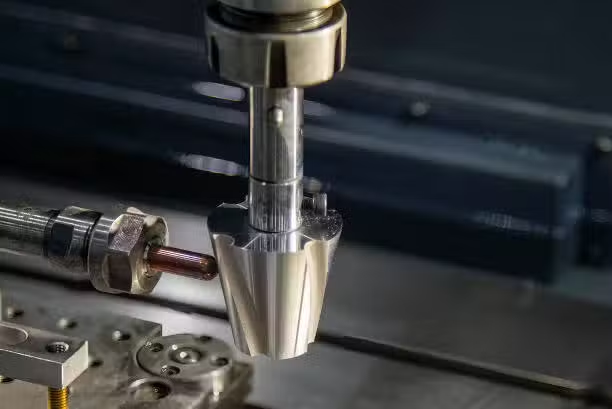
Wire Electrical Discharge Machining, or Wire EDM, is a non-contact, thermal machining process. Instead of using cutting tools, it utilizes a thin, electrically charged wire (typically made of brass) to slice through conductive materials. The process works by creating a series of rapid, controlled electrical sparks between the wire and the workpiece.
These sparks generate intense heat, melting and vaporizing microscopic particles of the material. A constant flow of deionized water cools the process and flushes away the removed particles. Because the wire never physically touches the workpiece, there are no cutting forces involved. This unique characteristic allows Wire EDM to create intricate shapes, sharp internal corners, and delicate features that would be impossible or extremely difficult to achieve with conventional machining. For projects demanding the highest level of accuracy, many turn to PRECISION WIRE EDM machining services.
Core Differences Between Wire EDM and CNC Machining
While both processes are automated and precise, their differences in mechanics, applications, and material capabilities are significant.
1. The Machining Process: Contact vs. Non-Contact
The most fundamental difference lies in how material is removed.
- CNC Machining: This is a mechanical, subtractive process. A rotating cutting tool makes physical contact with the workpiece to shear away material. This involves significant force and can induce stress into the part.
- Wire EDM: This is a thermal, non-contact process. It uses electrical sparks to erode the material without any physical force. The absence of tool pressure means there is no mechanical stress on the workpiece, making it ideal for fragile parts or thin-walled features.
2. Material Compatibility and Hardness
Your choice of material will heavily influence which process is more suitable.
- CNC Machining: This method is extremely versatile and can be used on a wide array of materials, including metals (aluminum, steel, brass), plastics (ABS, nylon, polycarbonate), and even wood. However, its effectiveness can decrease with extremely hard materials, which cause rapid tool wear and may require specialized, expensive cutters.
- Wire EDM: This process is limited to electrically conductive materials. It excels at cutting hardened metals like tool steel, titanium, and exotic alloys with ease. Since hardness does not affect the process—only conductivity does—Wire EDM can effortlessly cut materials that have already been heat-treated.
3. Precision and Complexity of Cuts
Both methods are known for their accuracy, but Wire EDM often has an edge when it comes to intricate details.
- CNC Machining: Capable of high precision, but limited by the physical size and shape of the cutting tools. Creating sharp internal corners is challenging, as the tool’s radius will always leave a small fillet.
- Wire EDM: Renowned for exceptional precision and the ability to produce extremely fine details. It can create sharp internal corners, complex contours, and patterns with tolerances as tight as ±0.0001 inches. The thin wire acts as a cutting edge, allowing for intricate shapes that are impossible for traditional mills.
4. Surface Finish
The resulting surface finish from each process is distinct.
- CNC Machining: The surface finish is dependent on factors like cutting speed, feed rate, and tool sharpness. It often leaves visible tool marks that may require secondary finishing processes like polishing or bead blasting to achieve a smooth surface.
- Wire EDM: This process typically produces a smooth, consistent matte finish with no tool marks. The quality of the finish can be controlled by adjusting the power and number of passes, often eliminating the need for subsequent polishing.
5. Production Speed and Cost
For many projects, speed and budget are primary concerns.
- CNC Machining: Generally offers faster material removal rates, making it more efficient for bulk material removal and producing larger parts. It is often more cost-effective for simpler geometries and medium-to-high volume production runs.
- Wire EDM: This is a slower process, as material is removed particle by particle. It is better suited for high-precision, low-volume work, or for creating tooling like molds and dies. While the per-hour rate can be higher, it can be more economical for complex parts that would otherwise require multiple setups or secondary operations with CNC.
Choosing the Right Partner for Your Machining Needs
Ultimately, the choice between Wire EDM and CNC machining depends on the specific requirements of your project: material, complexity, required tolerances, and budget. For parts requiring rapid production from a wide variety of materials, CNC machining is often the best path. For intricate designs, hardened materials, and uncompromising precision, Wire EDM is the superior choice.
In many cases, a hybrid approach that leverages the strengths of both technologies provides the best overall solution. Finding a manufacturing partner with expertise in both disciplines is key. A top-tier provider like AIXI CNC Machining Factory has the equipment and experience to guide you toward the most effective and economical manufacturing method for your unique components, ensuring your project is a success from start to finish.
Pathways That Lead Businesses to Growth
Behind the Bar: Exploring the Hidden Careers That Keep Britain’s Pubs Thriving
From Uncertainty to Stability: Why Malta Golden Visa Attracts a Growing Number of Wealthy Americans
Top 5 Reasons To Book Luxury Lodges Wales For Your Next Trip
Beyond Slicing: Pro Techniques to Convert PSD to HTML Email Without Breaking Your Layout
How to buy Toncoin (TON) with US dollars (USD)
Navigating the hardest parts of being a manager
Zoe Saldaña’s Mom, Asalia Nazario, Has a Story Worth Knowing
David Sanov: The True Story of Alison Sweeney’s Husband
Fashion Insider Guide: Choosing the Perfect Diamond Ring
Who Is Marlene Knaus? The Untold Story of Niki Lauda’s First Wife
Curious About JOI Database? Read This First Before You Click Anything
Jacqueline Bernice Mitchell: The Inspiring Story of Jerry Rice’s Ex-Wife
Where Is Barbara Boothe Now? Inside Her Life After Larry Ellison
Should You Use Wooflix in 2025? Honest Review and Best Alternatives
Where Is Noelle Watters Now? Jesse Watters’ Ex-Wife’s Life After Divorce
Alisande Ullman Today: What Happened After Her Divorce from Leslie Nielsen?
Mickey Middleton: The Untold Story of Bryan Cranston’s First Wife
Where Is Tanya Hijazi Now?: All About Rick James’ Former Wife
Wendy Lang: Meet the Therapist Married to Cenk Uygur
Pathways That Lead Businesses to Growth
Behind the Bar: Exploring the Hidden Careers That Keep Britain’s Pubs Thriving
From Uncertainty to Stability: Why Malta Golden Visa Attracts a Growing Number of Wealthy Americans
Top 5 Reasons To Book Luxury Lodges Wales For Your Next Trip
Beyond Slicing: Pro Techniques to Convert PSD to HTML Email Without Breaking Your Layout
How to buy Toncoin (TON) with US dollars (USD)
Navigating the hardest parts of being a manager
Zoe Saldaña’s Mom, Asalia Nazario, Has a Story Worth Knowing
David Sanov: The True Story of Alison Sweeney’s Husband
Fashion Insider Guide: Choosing the Perfect Diamond Ring
Categories
Trending
-
Celebrity6 months agoWho Is Marlene Knaus? The Untold Story of Niki Lauda’s First Wife
-
Entertainment5 months agoCurious About JOI Database? Read This First Before You Click Anything
-
Celebrity3 months agoJacqueline Bernice Mitchell: The Inspiring Story of Jerry Rice’s Ex-Wife
-
News3 months agoWhere Is Barbara Boothe Now? Inside Her Life After Larry Ellison