
Connect with us

Guide

How to Test Your Electric Fuel Pump: A Complete DIY Guide

Published

on

How to Test Your Electric Fuel Pump: A Complete DIY Guide
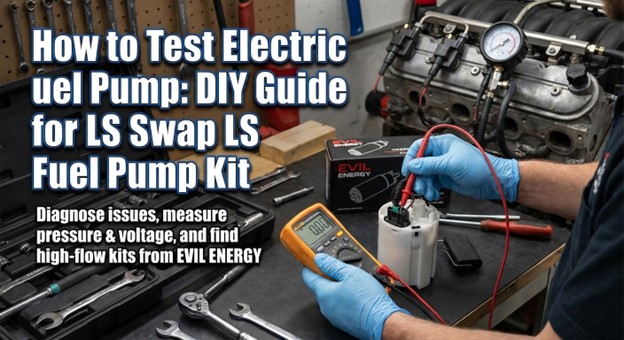
Introduction: Why Fuel Pump Testing is Crucial

Your Electric Fuel Pump is the heart of the Electronic Fuel Injection (EFI) system. Any drop in performance directly impacts your engine’s horsepower and starting reliability. For high-performance modified vehicles, especially those utilizing an LS Swap fuel pump kit, ensuring the pump delivers stable high pressure and flow is key to unlocking the engine’s full potential. This guide will walk you through two critical methods for quickly diagnosing and resolving fuel supply issues.

Part I: Diagnosis: When Do You Need to Test Your Fuel Pump?

  • Difficulty Starting or No-Start Condition: This is the clearest sign. When you turn the ignition key to the ON position (not starting), you should hear a brief “priming sound” from the fuel tank area. If you hear nothing, it indicates a circuit or pump body failure.
  • Engine Stalling or Misfiring: Especially under high load or aggressive acceleration, if the pump cannot meet engine demand, it leads to Fuel Starvation.
  • Loss of Power on Acceleration: You will feel a noticeable sluggishness in throttle response. This is particularly pronounced in turbocharged vehicles, as fuel pressure must increase with boost pressure.
  • Unusual Noise from the Fuel Tank (Loud or Whining): “What does a bad fuel pump sound like?” While a low hum is normal, if the sound becomes sharply high-pitched or continuously loud, it usually indicates the pump motor is struggling or excessively worn.


Part II: Preparation and Essential Tools

Before any diagnostic work, safely relieving the fuel system pressure is critical.

  1. Safety First: Disconnect the negative terminal of the car battery.
  2. Relieving System Pressure: Always consult your vehicle’s repair manual to safely release the residual pressure in the fuel lines.
  3. Key Tools:
  • Fuel Pressure Gauge: The core diagnostic tool for measuring the pump’s actual output.
  • Multimeter: Necessary for accurately measuring voltage and resistance.
  • Jumper Wires: Used for bypassing the relay to test the fuel pump’s power supply directly.


Part III: How to Test the Electric Fuel Pump

A. Method 1: Fuel Pressure Test – Checking Mechanical Performance

This is the most direct test of the Electric Fuel Pump’s mechanical health.

  1. Connect the Gauge: Locate the test port (Schrader Valve) on the fuel rail and securely attach the pressure gauge.
  2. Key ON/OFF Cycling (Priming): Turn the ignition key to the ON position, then OFF (do not start the engine). The fuel pump performs a priming cycle. Observe if the gauge reading reaches the manufacturer’s specified Static Pressure.
  3. Start and Idle Test: Start the engine and let it idle. Record the pressure reading at idle.
  4. Acceleration Test: Rev the engine quickly (or perform a safe road test). Observe if the pressure drops or fluctuates sharply during acceleration.
  5. Diagnosis:
  • Low Pressure: Indicates a fatigued fuel pump, or a clogged fuel filter (user high-frequency search: Can a bad fuel filter mimic a bad fuel pump?).
  • High Fluctuation: May suggest internal pump wear or a faulty Fuel Pressure Regulator.

B. Method 2: Electrical Circuit Test – Checking Power Supply Issues

  1. Check Fuse: Locate the fuel pump fuse. Use the multimeter to check for continuity.
  2. Locate Relay: Find the fuel pump relay. This is one of the most common failure points (How to test fuel pump relay).
  3. Test Relay Power:
  • Use jumper wires to connect the Constant Power and the Pump Terminal terminals in the relay slot, bypassing the relay to power the pump directly.
  • If the pump runs, the issue lies with the relay or control signal (ECU or safety switch).
  • If the pump still doesn’t run, proceed to the next step.
  1. Test Voltage at Pump: Measure the voltage directly at the fuel pump connector located above the fuel tank. If you measure 12V here but the pump fails to run, it is confirmed as an Electric Fuel Pump body failure.

Why Choose EVIL ENERGY Fuel Pumps?

High-performance engine fuel demands are enormous, and OEM pumps often reach their limits quickly. Choosing EVIL ENERGY products ensures your modified vehicle receives the necessary reliability and flow.

  • LS Swap Power Assurance: Our LS Swap fuel pump kit is engineered for large-displacement swaps and high-horsepower applications, offering superior Gallons Per Hour (GPH) flow and pressure stability compared to stock pumps, effectively eliminating fuel bottlenecks.
  • Superior Flow/Pressure Curve: EVIL ENERGY pumps maintain stable fuel pressure even under extreme loads and big boost, which is critical for turbocharged and supercharged engines relying on precise fueling.
  • Durable Reliability: We emphasize high-quality commutator and armature designs, ensuring the pump’s long-term durability in high-heat, prolonged operation environments, minimizing the risk of failure.
  • Broad Compatibility: Our fuel pumps and accessories (such as fuel pressure regulators and adapters) offer high universality, simplifying the installation and system upgrade process.


Part V: FAQs

Q: Can a bad fuel filter mimic a bad fuel pump?

A: Absolutely. A severely clogged fuel filter restricts flow and reduces pressure to the engine, producing symptoms identical to a failing pump. Always inspect or replace the filter during diagnosis.

Q: Is it safe to drive with a bad electric fuel pump?

A: No. A failing pump can cause sudden engine stalling, leading to hazardous situations. Prompt replacement is always recommended.

Q: How much does it cost to replace an electric fuel pump?

A: Costs vary widely based on the vehicle type (sedan vs. truck), pump accessibility, and whether you use an OEM replacement or a performance upgrade (like an LS Swap fuel pump kit). Labor costs are often high due to the fuel tank needing removal.

Q: What is the normal fuel pressure range for an EFI system?

A: Most modern Electronic Fuel Injection (EFI) systems typically operate in the range of 35 to 60 PSI, but always refer to your specific vehicle’s manufacturer specifications for the exact required pressure.


Conclusion

The electric fuel pump is fundamental to the health and performance of any Electronic Fuel Injection (EFI) system. Diagnosing a failing pump is crucial, as symptoms often include loss of power on acceleration, difficulty starting, or unusual whining noises from the tank.

The core diagnostic process relies on two critical methods:

  1. Fuel Pressure Test: Use a pressure gauge to verify the pump is meeting the required Static Pressure and maintaining stability under load. Low or fluctuating pressure often points to a worn pump or a clogged fuel filter.
  2. Electrical Circuit Test: Use a multimeter to check the fuel pump relay and voltage at the pump connector, ruling out common electrical failures.

For high-performance applications, such as an LS Swap fuel pump kit, using a reliable pump that delivers stable, high-volume flow is non-negotiable. EVIL ENERGY fuel pumps are engineered to provide the superior flow and durability needed to handle the extreme demands of turbocharged or modified engines, ensuring your vehicle performs consistently under all conditions.

Prompt repair and choosing the right high-performance components are essential for safety and maximum power.

Continue Reading

Categories

Trending