The modern Generative AI Contact Center is transforming customer experience in ways that were unimaginable just a few years ago. Today, businesses are no longer relying solely on scripts or basic chatbots; instead, they are leveraging a Generative AI platform for contact center automation that combines advanced natural language understanding, real-time data processing, and task automation to deliver faster, smarter, and more empathetic interactions.
These platforms often work hand-in-hand with RPA and AI platforms to handle repetitive tasks such as data entry, account updates, and transaction processing. This automation frees human agents to focus on more nuanced interactions, where empathy, critical thinking, and problem-solving are essential. By 2026, organizations see the Generative AI Contact Center not just as a support tool, but as a strategic engine that drives operational efficiency, customer satisfaction, and business growth. This article explores how Generative AI Contact Centers leverage these technologies to redefine customer engagement, improve operational efficiency, and set a roadmap for 2027 and beyond.
Core Technologies Driving the Generative AI Contact Center
Large Language Models (LLMs) & Agentic AI
At the heart of the Generative AI Contact Center are Large Language Models (LLMs), which now do far more than generate text—they can execute tasks autonomously. Agentic AI leverages these models to navigate internal systems, perform multi-step processes, and even escalate issues intelligently when human intervention is required.
For example, when a customer requests a complex change to their account, LLM-powered AI can verify identity, access multiple internal databases, and execute the update without human input. This shift from simple chatbot responses to autonomous task execution drastically reduces resolution times and improves customer satisfaction.
Retrieval-Augmented Generation (RAG) for Accuracy
Despite their power, AI models are prone to errors, often referred to as “hallucinations.” Retrieval-Augmented Generation (RAG) addresses this challenge by connecting AI directly to verified company knowledge bases, CRMs, and documentation. In a Generative AI Contact Center, RAG ensures that every answer is accurate, consistent, and aligned with company policies.
This capability is critical in industries like finance and healthcare, where errors can have serious consequences. Companies that adopt RAG see a measurable reduction in incorrect responses, boosting both trust and operational efficiency.
Multimodal Capabilities for Omnichannel Experiences
A true Generative AI Contact Center isn’t limited to chat. Modern systems integrate voice, video, and text, allowing customers to switch channels seamlessly while AI maintains full contextual awareness.
Imagine a customer starts a troubleshooting session via chat, escalates to a video call, and then follows up with email. In a Generative AI Contact Center, AI remembers the full conversation, ensuring continuity, personalized recommendations, and faster resolutions. This omnichannel capability is no longer optional—it’s expected by customers.
Real-Time Sentiment Analysis
One of the most advanced features of today’s Generative AI Contact Centers is real-time sentiment analysis. AI monitors voice tone, word choice, and interaction patterns to gauge a customer’s emotional state.
If the system detects frustration, it can trigger an instant escalation to a human agent or provide real-time guidance to the agent handling the call. By understanding emotions in real time, Generative AI ensures interactions remain empathetic, reducing churn and improving overall customer experience.
High-Impact Use Cases for Generative AI Contact Centers
- Next-Gen Self-Service: Self-service has evolved far beyond FAQs. Modern Generative AI Contact Centers handle multi-turn, complex inquiries independently. For instance, a telecom customer can troubleshoot network issues entirely through AI guidance without ever speaking to a human. Studies show that AI-powered self-service can resolve up to 60–70% of routine inquiries, freeing agents for more complex issues and significantly reducing customer wait times.
- Real-Time Agent Assist: AI also acts as a real-time co-pilot for human agents. When a customer asks a complicated question, the system can suggest the best responses, retrieve relevant documents, and even draft emails or chat messages in seconds. In practice, this reduces Average Handle Time (AHT) while improving accuracy and customer satisfaction, creating a more confident and capable workforce.
- Automated After-Call Work (ACW): Manual documentation is one of the most time-consuming aspects of customer support. Generative AI Contact Centers automate ACW by summarizing interactions, updating CRMs, and flagging follow-ups. This not only saves time but also ensures consistency and reduces errors in customer records.
For example, a financial services contact center reduced ACW time by 80% after implementing AI summarization, allowing agents to handle more interactions each day without sacrificing quality.
- Proactive Engagement: Predictive analytics enables Generative AI Contact Centers to engage customers before they even reach out. By analyzing historical data, AI can anticipate service disruptions, suggest product renewals, or flag potential dissatisfaction.
Proactive engagement strengthens customer relationships and drives loyalty, demonstrating the value of AI beyond reactive support.
Top 5 Generative AI Contact Center Solutions in 2026
Choosing the right platform is crucial for implementing a Generative AI Contact Center that scales efficiently while enhancing customer satisfaction.
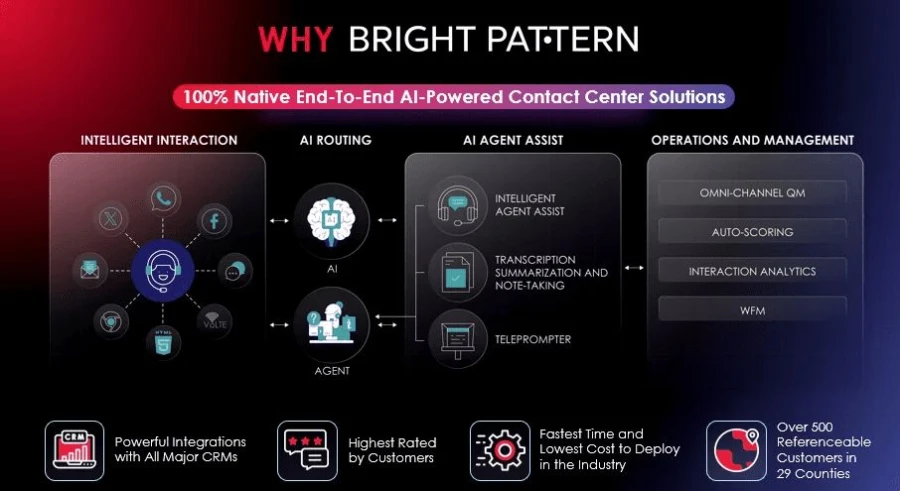
- Bright Pattern – Leading the pack in 2026, Bright Pattern stands out with its omnichannel-first AI approach, seamlessly integrating voice, messaging apps, SMS, and email into unified customer workflows. Its intuitive interface allows businesses to rapidly deploy AI-driven automation while maintaining control over customer interactions. With features like real-time agent assist, predictive routing, and AI-powered analytics, Bright Pattern is particularly suited for enterprises looking to scale their Generative AI Contact Center capabilities quickly and efficiently.
- Ultimate.ai (Zendesk) – Known for its deep CRM integration and highly accurate multi-lingual intent recognition, Ultimate.ai helps global organizations manage diverse customer bases with consistent quality. Its AI can resolve routine inquiries automatically while escalating complex issues to human agents, making it a strong option for companies aiming for highly personalized, AI-assisted customer service.
- Genesys Cloud CX – This enterprise-grade platform excels in large-scale orchestration, allowing businesses to deploy advanced Generative AI Contact Center functionalities across multiple departments and regions. Genesys Cloud CX combines AI-powered routing, automated self-service, and real-time analytics to ensure consistent and efficient customer experiences at scale.
- Nice CXone – Utilizing the Enlighten AI framework, Nice CXone delivers deep behavioral insights, real-time coaching, and actionable analytics to enhance agent performance. Its AI capabilities help supervisors identify patterns, optimize workflows, and ensure quality interactions, making it a powerful tool for performance-driven Generative AI Contact Centers.
- Talkdesk – Specializing in industry-specific AI solutions, Talkdesk provides tailored capabilities for verticals such as Healthcare, Retail, and Finance. Its AI-powered workflows, compliance features, and analytics tools enable companies to meet regulatory requirements while delivering personalized, efficient customer experiences.
Building the Foundation for Your Generative AI Contact Center
Implementing a Generative AI Contact Center requires a methodical approach. These steps help ensure success from day one.
- Data Hygiene & Infrastructure: Centralizing transcripts, CRM data, and knowledge bases is critical. Clean, organized data ensures AI learns accurately and delivers reliable responses.
- Defining Guardrails: Establish AI governance, ethical guidelines, and security protocols to maintain trust. Guardrails prevent misuse, ensure regulatory compliance, and protect customer data.
- Choosing Your Architecture: Select between cloud-based CCaaS or hybrid AI deployments based on your organization’s scale, compliance needs, and infrastructure. Each approach has trade-offs in cost, scalability, and control.
- The Pilot Program: Begin with high-volume, low-risk workflows such as FAQs or password resets. A controlled pilot allows teams to measure effectiveness, adjust workflows, and train human agents for AI collaboration before full-scale deployment.
Overcoming Challenges in Generative AI Contact Centers
Generative AI promises faster, smarter, and more personalized customer experiences, but implementing it comes with its own set of challenges. Organizations must thoughtfully address issues like accuracy, trust, and human collaboration to ensure a smooth, successful transition to AI-powered operations.
- Closing the Accuracy Gap: Even the smartest AI models aren’t perfect. Continuous fine-tuning, combined with human oversight, ensures that AI responses are not only fast but also correct. By reviewing outputs, feeding corrections back into the system, and monitoring performance, organizations can maintain reliability and keep customer trust intact.
- Data Privacy & Compliance: Handling customer data responsibly is critical. Generative AI Contact Centers must comply with regulations such as GDPR, TCPA, and other regional privacy laws. This means encrypting data, controlling access, and auditing AI workflows to protect sensitive information while still providing a seamless experience.
- Combating Deepfakes: As AI becomes more sophisticated, so do security threats. Voice biometrics and AI-generated interactions could be exploited by bad actors. Generative AI contact centers need advanced safeguards, including identity verification and anomaly detection, to prevent impersonation and maintain secure, trustworthy communication.
- Managing Workforce Anxiety: The introduction of AI can create uncertainty among human agents. Upskilling employees as AI Managers empowers them to supervise AI systems, handle exceptions, and focus on complex, high-value interactions. This not only reduces anxiety but also fosters collaboration between humans and machines, turning AI into a supportive teammate rather than a replacement.
Measuring Success in a Generative AI Contact Center
Traditional KPIs like handle time are no longer enough. Generative AI Contact Centers require new metrics to track efficiency, customer satisfaction, and ROI.
- Automated Resolution Rates: Measures how effectively AI handles inquiries without human intervention.
- Sentiment-Adjusted CSAT: Captures the emotional quality of interactions, providing insight beyond simple satisfaction scores.
- ROI of GenAI: Assesses the cost-per-interaction shift as AI absorbs repetitive tasks, quantifying operational and financial gains.
Conclusion: The Future of Generative AI Contact Centers Beyond 2026
The next frontier is AI-to-AI interactions, where a customer’s personal AI communicates directly with a brand’s AI to resolve issues seamlessly. Success will favor businesses that integrate AI thoughtfully—balancing automation with human oversight, monitoring performance continuously, and enhancing agent skills.
By 2027 and beyond, Generative AI Contact Centers will be the standard for customer engagement—faster, smarter, and more empathetic than ever. Organizations that embrace this transformation will not just improve efficiency—they will redefine customer experience for a new era.