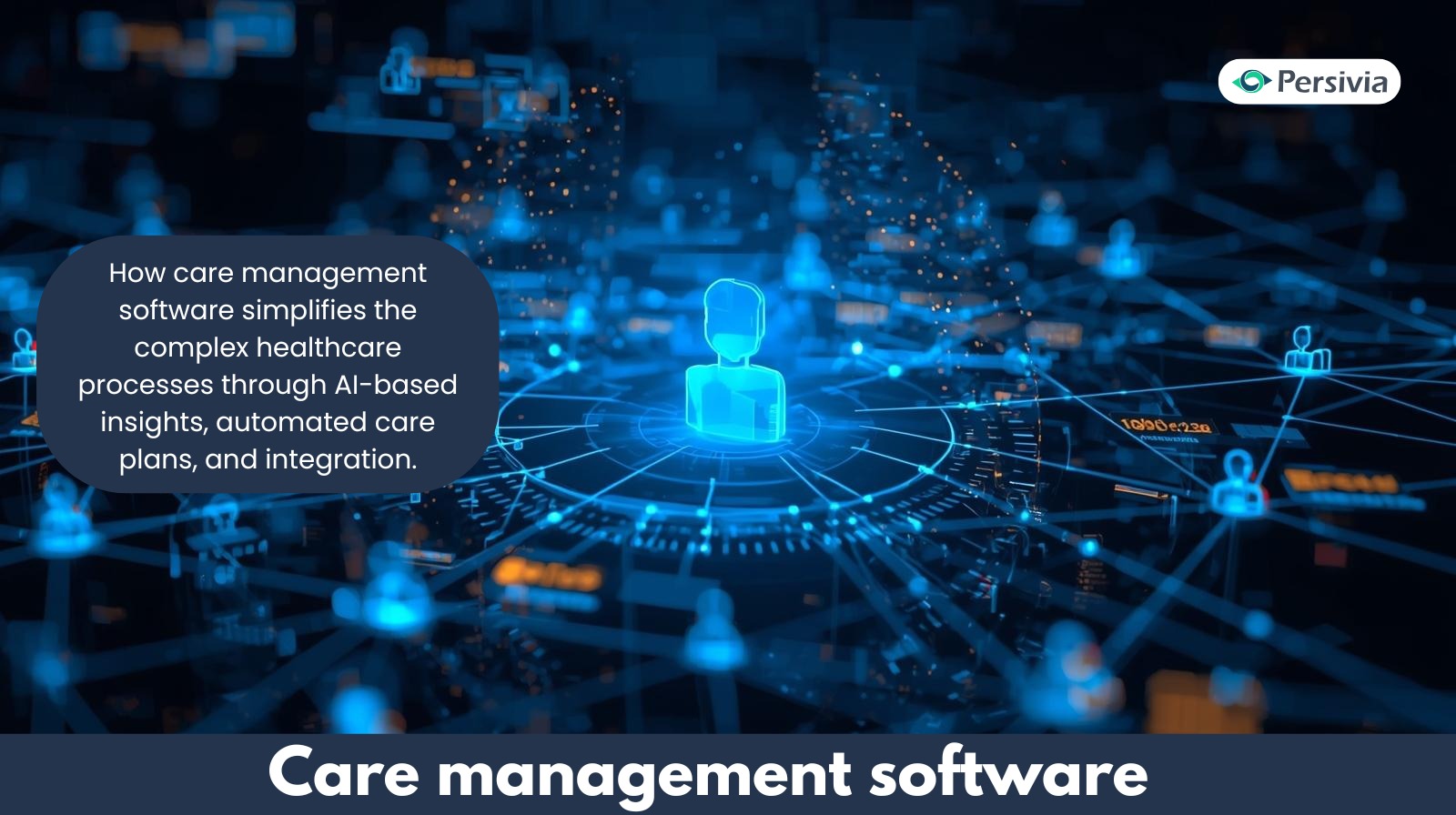
Teams in healthcare are dealing with hundreds of patients in various facilities, and each patient has his/her own conditions, treatment, and care requirements. Care management software simplifies this complicated situation by bringing together all the information about patients that occurs in each touchpoint in a single system. There is no longer a need to alternate between distinct EHR screens, claims databases, and spreadsheets in order to compile a story of a patient.
These sites do not merely store information. They actively inform care decision-making. AI algorithms examine the information about patients in real-time, identify high-risk cases, propose evidence-based actions, and perform automatic processes. The care teams waste less time in their quest to find information and more time in providing coordinated care that will prevent readmission to hospitals and enhance patient outcomes.
What is Integrated Care Management Software?
Care management software is the software that brings together clinical data, claims data, device monitoring, and patient-reported outcomes in a single longitudinal record. It follows patients through hospitals and clinics, home health, and specialty care, and automates coordination activity, which once took hours of manual work.
Core Capabilities That Drive Results
Essential features include:
- Real-time data aggregation: Pulls information from EHRs, insurance claims, remote monitoring devices, and patient mobile apps into one interface
- AI-powered risk stratification: Identifies patients who need immediate attention based on clinical and utilization patterns
- Automated care plan generation: Uses evidence-based clinical pathways to create personalized intervention plans
- Workflow automation: Routes tasks to appropriate team members without manual assignment
- Multi-channel communication: Enables patient engagement through text, video, and secure messaging
A Digital health platform ensures care teams have access to up-to-date patient information across hospitals, clinics, and home care visits.
Why Traditional Workflows Create Bottlenecks
Manual processes used in care coordination that are not integrated with technology are time-consuming, and they are prone to error. Care managers waste their time and look into records that are spread out in various locations, call around in search of information, and populate a spreadsheet manually.
Common Problems in Fragmented Systems
Traditional workflows create multiple bottlenecks that waste time and compromise care quality:
- Information silos: Staff log into multiple systems to understand one patient’s situation, clinical notes in the EHR, authorizations in the payer portal, and social needs in separate case management tools
- Delayed insights: Teams discover problems only after reviewing last week’s reports, often after patients have already visited the emergency department
- Duplicate efforts: Different team members contact the same patient about separate issues because nobody has visibility into others’ activities
- Missed care gaps: Patients go without recommended screenings, vaccinations, or chronic disease monitoring until annual chart reviews.
Workflow breakdowns harm patient outcomes and increase costs through preventable hospitalizations and emergency visits.
How Integrated Platforms Transform Care Delivery
Integrated systems remove the manual bottlenecks by linking all the data sources together, as well as automation the repetitive tasks. Care teams operate based on precise up to date data, whereas AI handles routine decision-making and task routing.
Centralizing Patient Data Across All Touchpoints
The platform links with EHRs of hospitals, laboratory systems, radiology, insurance claims databases, community health records, and patient apps and device-generated data. All the inputs are incorporated in a single longitudinal patient record.
In the case that a patient presents himself in the emergency department during the night, his care manager is the first to view the admission in the morning. In the case of a patient filling in a health assessment on their phone, the information is instantly shown in his or her care plan. Laboratory outcomes are also activated to issue an automatic warning when the metrics are out of bounds.
The platform consolidates real-time data automatically, requiring no staff intervention. Care managers always operate on the latest information they have.
Automating Risk Stratification and Patient Prioritization
The AI analysis of patient data is constantly performed to derive the risk score of hospital re-hospitalization, disease progression, and non-adherence to treatment. The system takes into account the recent usage patterns and severity of chronic conditions, the adherence to medications, social aspects such as the stability of housing, and missed appointments.
High-risk patients are automatically prioritized on daily worklists. Examples include a diabetic patient with spiked glucose levels, a heart failure patient with rapid weight gain, or a recently discharged patient who missed follow-up care.
Care managers spend their scarce time on patients who are likely to experience benefit with an immediate intervention, as opposed to sifting through hundreds of charts manually in order to find troubling trends.
Generating Evidence-Based Care Plans Automatically
The platform takes the form of clinical decision support algorithms run on patient data to automatically generate individualized intervention plans instead of developing care plans in isolation. It consists of glucose monitoring guidelines, nutritional education, drug administration assignments, and specialist referral processes for a newly diagnosed diabetic patient.
Streamlining Team Communication and Task Distribution
The platform routes work to the appropriate team members automatically. Dietitian consultations go to dietitians, medication reconciliation tasks route to pharmacists, and transportation assistance requests reach social workers.
Integrated communication features include:
- Secure messaging about specific patients between team members
- Built-in video calls for telehealth appointments
- Automated patient outreach via preferred channels
- Real-time notifications for urgent situations
Everyone sees what others have completed, eliminating confusion about whether someone has already contacted the patient or submitted a referral.
Identifying and Closing Care Gaps Proactively
AI compares patient records with quality measures and program requirements to determine the lack of preventive care, undone screenings, and unmonitored chronic diseases. These lapses are displayed in workflows of care managers containing certain action items and patient outreach draft messages.
In the case of value-based care programs, this has a direct effect on the score on quality and incentives. The platform prioritizes gaps in terms of the measures they impact and proposes effective interventions to address a range of gaps at once.
Integrating Clinical Decision Support at the Point of Care
Best care management software delivers patient-specific information directly within provider workflows. When physicians visit a care plan during primary care, they can view recent care plan progress and any recent interactions with the care manager and the future preventive care without leaving their EHR.
Clinical alerts are displayed at the right time when patients with chronic pain should be screened for depression, when medications are to be given in combinations or with other drugs, or when a patient should be changed to another medication following recent laboratory trends.
Enabling Continuous Remote Monitoring
Patients use mobile apps to report symptoms, complete assessments, view care plans, and message care teams. Connected devices automatically transmit vital signs and measurements.
The software monitors incoming data and alerts care managers to concerning changes. Rising blood pressure readings trigger outreach tasks. Worsening symptom scores prompt telehealth check-ins. Missed medication doses generate reminder messages.
This continuous monitoring catches problems early when they’re easier and less expensive to address.
Reducing Administrative Burden Through Intelligent Automation
Workflow automation eliminates repetitive manual tasks:
- Appointment reminders are sent automatically via patients’ preferred channels
- Care plan tasks are generated and assigned based on protocols
- Progress notes auto-populate with completed activities
- Reports compile automatically for program directors and payers
- Documentation is captured through structured data entry
Care teams spend more time in meaningful patient interactions and less on paperwork.
Key Features in Effective Care Management Platforms
Comprehensive Data Integration Capabilities
Strong care management software vendors offer pre-built connections to major EHR systems, health information exchanges, and claims clearinghouses. The platform should accept structured and unstructured data, using natural language processing to extract information from clinical notes, discharge summaries, and referral documents.
Essential integration features:
- Bidirectional EHR data exchange
- Real-time claims feed ingestion
- API connections for custom sources
- Device integration for remote monitoring
- HL7 and FHIR standards compliance
Sophisticated AI and Predictive Analytics
A machine learning algorithm is supposed to improve with time as it learns about your patient population and results. Analytics needs to be readmission and utilization risk predictive, identify care gaps across quality programs, segment patients into groups to respond to, and track the total cost of care.
The system should explain AI recommendations so care teams understand the rationale behind each suggested intervention.
Configurable Clinical Content Libraries
Ready-made evidence-based pathway saves time of implementation, yet you require being able to tailor protocols to your population. The platform would contain wide libraries of clinical pathways and enable clinical personnel to edit or create new clinical pathways without necessitating IT development.
Intuitive User Experience
Care managers use the software all day, so interface design directly impacts efficiency. The platform should present important information prominently, minimize clicks for common tasks, and adapt to different roles’ workflow patterns.
Critical usability factors:
- Role-based dashboards showing relevant information first
- Quick patient record and care plan access
- Mobile optimization for field-based care managers
- Bulk action capabilities for common tasks
- Customizable views and filters
Patient Engagement Tools
The platform must offer mobile applications, web portals, text messaging, and voice features that can suit the comfort level of every patient in terms of technology. The characteristics of engagement must truly render easy medication tracking, easy symptom reporting, easy scheduling, and easy messaging care team.
Integrated Telehealth Capabilities
Video visits within the care management platform are more efficient than separate tools. The care managers access the complete patient record at the time of the call, revise the care plan immediately, and record the encounter without a change of application. Billing integration makes sure that the telehealth visits are properly captured and coded.
Implementation Strategies for Success
Workflow Mapping and System Configuration
Document current care management workflows in detail before implementation. Determine bottlenecks, unnecessary steps, and manual workarounds that must be removed. Install the platform with optimized workflows instead of making teams adjust to software processes that are stiff.
Data Migration and Quality Validation
Moving historical patient data requires careful planning. Choose the most important information items, the extent of information migration, and discrepancies between other information sources. Check accuracy post migration by spot-checking records against sources.
Staff Training and Change Management
Offer practical training and not feature instruction. Establish the training environments in which the staff is trained to use the usual workflows without any impact on the live data. To resolve resistance, communicate the decisions to the frontline staff during configuration and emphasize the way the platform eradicates existing pain points.
Phased Rollout Approach
It is worth thinking about rolling out a single care management program or patient group instead of attempting to roll out everything at the same time. A gradual process will enable you to streamline the processes, test integrations, and gain staff confidence before the expansion.
Monitor individual indicators at every stage, the time spent on tasks, the rates of care gap elimination, and the satisfaction of staff members to assess the advancement and determine the areas that require modification.
Measuring Success and Return on Investment
Clinical Quality Improvements
Monitor the impact of the platform on patient outcomes, changes in the hospital readmission rate, ED use, quality measures, closing care gaps, patient adherence to medication, and disease-specific indicators (HbA1c control or blood pressure control).
Compare the results with the pre-implementation baselines and industry benchmarking.
Operational Efficiency Gains
Measure Patient care time on administrative activities compared to engagement with patients, tasks performed by the care manager in one day, high-risk warning time, and decreased documentation time.
These efficiencies are usually the easiest to give the clearest ROI during the first year, as they enable the teams to handle increased patients without the need to recruit extra personnel.
Financial Performance
For value-based care programs, connect platform usage to financial outcomes shared savings earned or penalty avoidance, quality bonus achievement, total cost of care reduction, and preventable acute care cost savings.
Many organizations see platforms pay for themselves through improved value-based contract performance alone.
Takeaway
Integrated care management software eliminates workflow inefficiencies, enabling healthcare teams to deliver proactive and coordinated care. These platforms enable care managers to work on patient retention because they automatically curate patient data, risk identification, evidence-based care plans, and intelligent routing of work. The right platform would turn care coordination into a continuous scramble to a smooth, scalable process where all patients get timely and relevant interventions.
Persivia offers CareSpace®, an AI-driven care management platform that delivers exactly what your care teams need to manage complex patient populations effortlessly. With 9,000 evidence-based clinical rules, 200+ built-in care pathways, and seamless integration across the care continuum, CareSpace® reduces readmissions while cutting provider workload significantly.
Organizations using the platform see measurable improvements in patient outcomes and operational efficiency within months. Stop struggling with fragmented workflows and disconnected systems.
Frequently Asked Questions
- What is integrated care management software?
Yes, it’s a platform that consolidates patient data from multiple sources into one system, automates care coordination tasks, and provides AI-driven insights. It tracks patients across all care settings while enabling seamless team communication and workflow automation.
- How does care management software reduce hospital readmissions?
Yes, by identifying high-risk patients automatically, flagging care gaps before problems escalate, and ensuring timely follow-up after discharge. The platform monitors patients continuously and alerts care managers to concerning changes that need immediate intervention.
- Can care management platforms integrate with existing EHR systems?
Yes, modern platforms connect bidirectionally with major EHR systems through HL7 and FHIR standards. They pull clinical data automatically and can push care plan information back into provider workflows at the point of care.
- How long does implementation typically take?
No, implementation timelines depend on integration complexity and organizational size, usually ranging from three to nine months. Starting with a phased rollout for one program or patient group often delivers faster results than organization-wide launches.
- What ROI can organizations expect from care management software?
Yes, organizations typically see returns through improved value-based care performance, reduced readmissions, and increased care manager productivity. Many platforms pay for themselves within the first year through quality bonuses and shared savings alone.