
Games
Why AI Is a Game Changer for New Developers
Published
1 day agoon
By
Prime Star
We’ve all had that moment. You’re playing a game, totally immersed in the world, and suddenly a spark ignites: “I want to make something like this.” You start brainstorming mechanics, sketching characters, and dreaming up lore. But then, reality hits.
You look up tutorials and realize you need to learn C# or C++. You look at asset stores and realize quality art costs thousands of dollars. You think about music and realize you don’t know the first thing about composition. For decades, these barriers technical skill, budget, and team size, have kept countless brilliant game ideas locked inside the minds of aspiring creators.
But the landscape is shifting. We are entering an era where AI for game development is fundamentally changing the rules of engagement.
Artificial Intelligence is no longer just a buzzword for tech giants; it is a practical, accessible toolkit that is leveling the playing field for indie developers and beginners. Whether you are a solo developer working out of your bedroom or a small team of students, AI is the bridge that can take you from “I have an idea” to “I have a playable game.”
This isn’t about robots replacing human creativity. It’s about empowerment. It’s about having a tireless assistant who can help you write code, generate textures, compose music, and flesh out narratives, allowing you to focus on what matters most: your vision.
Generating Code and Logic with AI
For many aspiring game designers, coding is the “final boss” they can’t seem to defeat. The logic, syntax, and sheer volume of scripting required to make even a simple platformer can be incredibly intimidating. This is where AI steps in as your personal programming partner.
AI-powered coding assistants are transforming how we write software. These tools don’t just spit out random lines of text; they understand context. They can suggest whole blocks of code, auto-complete repetitive functions, and even explain why a certain script isn’t working.
Tools to Watch
- GitHub Copilot: Perhaps the most famous example, Copilot integrates directly into your code editor. It learns from billions of lines of public code to suggest functions and algorithms in real-time.
- Tabnine: Similar to Copilot but with a strong focus on privacy and local models, Tabnine uses AI to predict and suggest the next chunk of code you’re likely to write.
Why This Matters for Beginners
For a novice, these tools are invaluable for learning. Instead of getting stuck on a syntax error for three hours, an AI assistant can spot the missing semicolon or suggest the correct function call instantly. It speeds up prototyping significantly, allowing you to get your character moving and jumping in minutes rather than days. It essentially acts as a senior developer looking over your shoulder, guiding you through the complex logic of game engines like Unity or Unreal.
Creating Art and Assets on a Budget
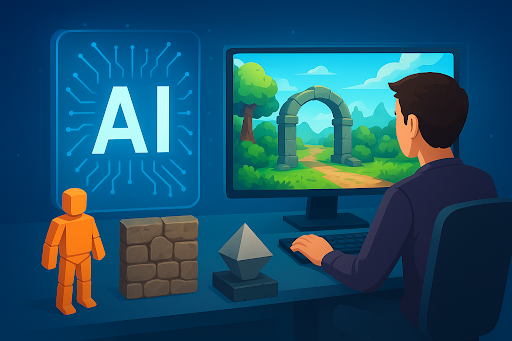
If coding is the brain of the game, art is its soul. Traditionally, this has been the most expensive part of development. You either had to spend years mastering Blender and Photoshop, or you had to hire professional artists. For a solo indie dev with zero budget, this often meant using generic “programmer art” (think floating cubes and capsules) that failed to convey the game’s atmosphere.
AI for game development has perhaps made its biggest splash in the visual department. Generative AI tools can now create stunning 2D images, textures, and even 3D models from simple text prompts.
Tools to Watch
- Midjourney: Known for its artistic flair, this tool is excellent for creating concept art, background environments, and UI elements.
- Leonardo AI: A platform specifically tailored for game assets, offering greater control over style and consistency than general image generators.
- Luma AI: This tool is pushing boundaries in 3D, allowing users to generate 3D models and assets that can be imported directly into game engines.
Why This Matters for Beginners
These tools allow for rapid visual prototyping. You can instantly visualize what your cyberpunk city or fantasy dungeon looks like without spending a dime. It reduces reliance on expensive asset stores where you might find five other games using the same character model. With AI in game design, you can generate unique, royalty-free assets that give your project a distinct identity, even if you can’t draw a stick figure.
Designing Immersive Worlds and Narratives
A great game needs a great story. But writing thousands of lines of dialogue, creating deep lore for every item, and fleshing out the backstories of fifty different NPCs is a massive undertaking. Writer’s block is a real threat to momentum.
Large Language Models (LLMs) act as an infinite idea generator. They can help you brainstorm quest lines, write flavor text for items, or create dynamic conversations that react to player choices.
Tools to Watch
- ChatGPT & Claude: These general-purpose chatbots are incredible at world-building. You can feed them a premise, “a post-apocalyptic world overrun by sentient plants,” and ask them to generate factions, history, and character motivations.
- Scenario: This platform specializes in fine-tuning AI models on your own style, ensuring that the generated content matches the specific tone and aesthetic of your game world.
Why This Matters for Beginners
These tools add depth to your game world that would essentially be impossible for a single person to achieve manually. You can populate a town with unique NPCs, each with their own generated backstory, in a fraction of the time. It allows for more complex storytelling and helps overcome the “blank page syndrome” that kills so many projects before they start.
Composing Music and Sound Effects
Audio is often the forgotten child of indie game development. Many beginners leave it until the very last minute, slapping on generic stock music that doesn’t quite fit the mood. But sound is crucial for immersion; the right track can make a boss fight feel epic or a horror hallway feel terrifying.
Hiring a composer is expensive, and learning music theory takes years. AI music generators are bridging this gap by allowing non-musicians to create custom, royalty-free soundtracks.
Tools to Watch
- Soundraw: This tool allows you to customize the length, tempo, mood, and instruments of a track, generating a unique composition that fits your specific scene.
- AIVA: An AI composer that creates emotional soundtrack music. It’s particularly good for classical and cinematic styles.
Why This Matters for Beginners
You get custom audio that actually fits the length and vibe of your gameplay. Instead of editing your level to fit a stock track, you can generate a track that fits your level. It provides professional polish without the professional price tag, ensuring your game sounds as good as it looks.
The Future of Indie Development is Collaborative
The democratization of game development is here. AI tools for indie developers are smashing down the gates that have kept creators out for so long.
We are moving away from a world where you need to be a “jack of all trades,” a master coder, artist, writer, and composer to build a game. Instead, we are moving toward a future where you can be a director. You provide the vision, the creative spark, and the direction, while AI tools handle the heavy lifting of execution.
Remember, these tools are collaborators, not replacements. They cannot replicate the unique human soul of a game the quirky humor, the emotional beats, the innovative mechanics that come from your personal experiences. But they can clear the path so that your unique voice can be heard.
So, if you’ve been sitting on a game idea, waiting for the “right time” or the “right skills,” stop waiting. The tools are here. The barrier to entry has never been lower. Pick a tool, start experimenting, and build the game you’ve always wanted to play.
Common Types of Hose Clamps
10 Thoughtful New Year Gifts to Start the Year Right
Preparing Your Property for Every Season With Professional Help
Why Outdoor Work Is Becoming More About Strategy Than Strength
Why Simplicity Plays a Bigger Role in Miniature Painting Than Most Players Expect
Inside the Rise of Targeted Supplements for Women’s Health
Why AI Is a Game Changer for New Developers
Enhancing Business Operations with Address Lookup API and Validation Tools
MerritEquity.com Review: How Useful Are Its Technical Indicators for Long-Term Pattern Analysis?
Pathways That Lead Businesses to Growth
Who Is Marlene Knaus? The Untold Story of Niki Lauda’s First Wife
Curious About JOI Database? Read This First Before You Click Anything
Jacqueline Bernice Mitchell: The Inspiring Story of Jerry Rice’s Ex-Wife
Where Is Barbara Boothe Now? Inside Her Life After Larry Ellison
Should You Use Wooflix in 2025? Honest Review and Best Alternatives
Where Is Noelle Watters Now? Jesse Watters’ Ex-Wife’s Life After Divorce
Alisande Ullman Today: What Happened After Her Divorce from Leslie Nielsen?
Mickey Middleton: The Untold Story of Bryan Cranston’s First Wife
Where Is Tanya Hijazi Now?: All About Rick James’ Former Wife
Wendy Lang: Meet the Therapist Married to Cenk Uygur
Common Types of Hose Clamps
10 Thoughtful New Year Gifts to Start the Year Right
Preparing Your Property for Every Season With Professional Help
Why Outdoor Work Is Becoming More About Strategy Than Strength
Why Simplicity Plays a Bigger Role in Miniature Painting Than Most Players Expect
Inside the Rise of Targeted Supplements for Women’s Health
Why AI Is a Game Changer for New Developers
Enhancing Business Operations with Address Lookup API and Validation Tools
MerritEquity.com Review: How Useful Are Its Technical Indicators for Long-Term Pattern Analysis?
Pathways That Lead Businesses to Growth
Categories
Trending
-
Celebrity6 months agoWho Is Marlene Knaus? The Untold Story of Niki Lauda’s First Wife
-
Entertainment5 months agoCurious About JOI Database? Read This First Before You Click Anything
-
Celebrity3 months agoJacqueline Bernice Mitchell: The Inspiring Story of Jerry Rice’s Ex-Wife
-
News3 months agoWhere Is Barbara Boothe Now? Inside Her Life After Larry Ellison