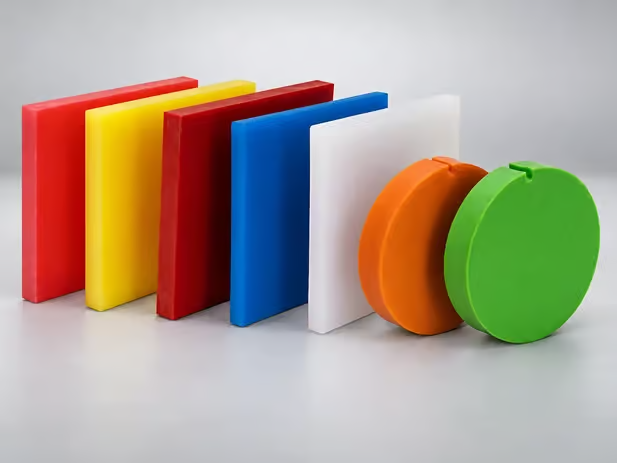
When purchasing an HDPE sheet, the size and thickness not only affect the material price, but also affect the cutting quantity, transportation method, installation and subsequent use. Oversizing may increase the residual material and handling costs; improper thickness selection may result in parts deformation, excessive weight or processing difficulties.
Select custom hdpe sheets you need to consider both the finished product size, operating conditions, processing methods, and acceptable tolerance. For bulk orders, you should also compare the material utilization of different original board sizes, instead of just looking at the quotation of a single board.
This article will introduce the expression of common specifications and show how to compare different size schemes through calculation examples.
What Do Custom HDPE Sheet Sizes and Thicknesses Mean?
Custom HDPE sheet sizes refers to the length and width of the sheet determined according to the project requirements. The deliverables can be unprocessed whole plates, cut rectangular plates, or finished parts containing holes, slots, or complex contours.
Standard Sheets, Cut-to-Size Sheets, and Custom Production
When purchasing, three different modes of supply should be distinguished:
- Standard sheet: purchase the supplier’s regular specifications of the whole plate, and then by the buyer or processor to complete the subsequent cutting.
- Cut-to-size sheet: cut out the specified size from the existing plate and deliver the parts of rectangular plate or simple shape.
- Custom production: manufacture plates of specific size or other specifications according to order requirements; feasibility, quantity and delivery time need to be confirmed with supplier.
These three approaches correspond to different cost structures. Standard sheet may be more convenient to arrange subsequent processing, but the buyer needs to deal with the surplus; cut-to-size sheet can reduce on-site work, but the unit price may include processing costs. Custom production requires further confirmation of production conditions and minimum order quantities.
“Custom size” also does not necessarily mean that the thickness can be arbitrarily specified. Different grades, colors, and surface finishes may only correspond to partial size combinations.
Nominal Thickness vs. Finished Thickness
Nominal thickness it is the nominal value used to identify and order the sheet, and does not mean that the measured value at each position of the sheet is exactly the same as this number.
Finished thickness it is the target thickness of the part after the agreed processing. If the part needs to fit closely with a metal groove, frame, or other component, just writing the nominal thickness may not be enough. The allowable range, measurement location and inspection conditions shall be specified in the drawing or order.
What Are Common HDPE Sheet Sizes and Thicknesses?
The available specifications for HDPE sheet vary by manufacturer, region, grade and mode of delivery. The following table lists common expressions that may be encountered in procurement to aid in comparison and does not mean that all suppliers provide every 1 combination.
| Sheet format |
Approximate metric equivalent |
Buying consideration |
| 4 × 8 ft |
1,219.2 × 2,438.4mm |
Common reference format; confirm actual nominal dimensions |
| 4 × 10 ft |
1,219.2 × 3,048mm |
May reduce joints or improve yield for longer parts |
| 1,000 × 2,000mm |
Approximately 3.28 × 6.56 ft |
Confirm grade and thickness availability |
| 1,220 × 2,440mm |
Approximately 4.00 × 8.01 ft |
A common metric format; not exactly 4 × 8 ft |
| Custom-cut size |
As specified |
Confirm finished dimensions, tolerance and quantity |
In the drawings, 4 × 8 ft is sometimes approximately written as 1,220 × 2,440mm, but the two are not exactly equal. If parts must fit into an existing frame, or if the size of the original plate directly affects the number of typeset, confirm which set of nominal dimensions is used for the order.
Common thickness may also be expressed in inches or mm:
| Nominal thickness |
Exact metric conversion |
Example buying consideration |
| 1/8 in |
3.175mm |
Check handling, support and finished-part requirements |
| 1/4 in |
6.35mm |
Check the available grade and sheet format |
| 1/2 in |
12.7mm |
Review weight, support and machining needs |
| 3/4 in |
19.05mm |
Confirm stock availability and thickness tolerance |
| 1 in |
25.4mm |
Consider handling weight and fabrication requirements |
The above table is an example of unit conversion and is not a recommended thickness by application. Metric nominal such as 3mm, 6mm, 12mm or 20mm may also be used in the market, which are not exactly the same as the similar inch size. For parts with strict fit requirements, clear values and units shall be used in the drawings.
Why Availability Varies by Grade and Supplier
Different production equipment, material grades and delivery methods will affect the available size combinations. The 12 mm thickness of a certain color does not mean that the same color must have 20 mm thickness. A certain thickness can provide a standard sheet, nor does it necessarily mean that a larger custom sheet can be provided.
When comparing quotes, it is best to submit the target grade, color, surface finish, length, width, thickness, and quantity at the same time. This allows the supplier to confirm the entire specification combination, rather than each individual condition separately.
How to Choose the Right HDPE Sheet Thickness
The choice of Thickness should start with the conditions of use of the finished part. First determine the load and allowable deformation to be borne, and then compare the available specifications and processing methods.
Consider Load, Support Spacing, and Deflection
The same thickness of the plate, if the support spacing is different, the use of performance may be significantly different. When selecting, record:
- Load size and contact area.
- Whether the load is short-term, periodic, or continuous.
- Plate support position and support spacing.
- Working temperature and allowable deflection.
- Whether the part assumes a safety or structural function.
Under the same other conditions, increasing the thickness can usually improve the stiffness of the plate. However, adjusting the support structure may also improve performance, so thickness should be evaluated in conjunction with the installation design.
For long-term stress parts, also need to consider creep. Short-time testing does not automatically prove that the part will maintain the required dimensions under long-term load. Engineering verification for specific design shall be performed when bearing, safety or critical equipment functions are involved.
Account for Wear, Temperature, and Service Life
If the plate is used as a wear liner, the initial thickness needs to consider the acceptable wear allowance, maintenance period and fixing position. The actual wear rate is also affected by the contact material, pressure, movement speed and contaminants, and cannot be predicted by thickness alone.
Temperature also affects material behavior and dimensions. Minimum and maximum operating temperatures and the duration of the corresponding temperatures shall be provided. If there is a thermal cleaning or a short period of high temperature, it should also be included in the evaluation.
Balance Thickness, Weight, and Machining Needs
Thicker plates increase weight and material usage, and may also affect handling, transportation and cutting time. For parts that need to be machined to the final thickness, the blank size and machining allowance should also be confirmed with the supplier.
Choose the minimum thickness that meets the verified performance and acceptance requirements, with the appropriate design margin.
This does not mean that the thinnest sheet should be selected directly. The design margin shall be determined according to the load, the use environment, the material data and the project requirements, and shall not be verified by the unified experience value.
How to Select the Right Sheet Size for Your Parts
After the size of the finished product is determined, the next step is to compare the utilization rate, processing methods and transportation requirements of different original boards.
Compare Standard Sheets and Custom-Cut Panels
If you have stable processing equipment, surplus usage and on-site space, standard sheets may be suitable for self-typesetting. For projects with fixed dimensions but limited on-site processing capacity, custom-cut panels can reduce internal cutting and handling work.
If the part size is close to the boundary of the original plate, the actual available size of the original plate, the edge finish range and the cutting tolerance shall be confirmed with the supplier. Do not judge whether parts can be arranged only according to the nominal sheet size.
Calculate Material Yield and Offcuts
Assume the project needs to be sized 400 × 600mm the rectangular part of. The following example is used only to compare typesetting methods and make these assumptions:
- Available panels are 1,200 × 2,400mm and 1,500 × 3,000mm.
- All parts are arranged in the same direction without mixing rotation.
- The cutting allowance between the parts is 5mm.
- Keep 10mm edge trim around the plate.
- Defects, clamping limitations or other machining losses are not considered.
| Usable sheet size |
Parts across width |
Parts along length |
Total parts |
Part-area yield |
| 1,200 × 2,400mm |
2 |
3 |
6 |
50.0 percent |
| 1,500 × 3,000mm |
3 |
4 |
12 |
64.0 percent |
Taking a smaller plate as an example, the available width is 1,200 − 20=1,180mm. Two 400mm parts and a 5mm slit in the middle 805mm; the 3 part is required 1,210mm, over the available width. Therefore, only two parts can be arranged in this direction.
Larger plates can be arranged three along the width and four along the length, resulting in a total of 12 parts. According to the finished product area, Part-area yield = 12 × 400 × 600 ÷ (1,500 × 3,000) = 64.0%.
This result only applies to the above typography directions and assumptions. Rotating parts, using mixed typesetting or changing cutting and trimming requirements may result in different results; the actual typesetting should also be confirmed by the processor.
A higher yield does not necessarily mean a lower total cost. If the large board is more expensive to transport, handle or process, these costs need to be compared with the material cost savings.
Consider Handling and Shipping Limits
Larger sheets may reduce seams or increase the number of typography, but may also be limited by vehicle size, loading and unloading equipment, storage space and site access.
When comparing the options, please confirm that the delivery location can be safely unloaded and stored, and check the weight of the sheet, the packaging method and the maximum size allowed. If large panels cannot be handled on site, cut-to-size in advance may be more suitable for the project.
How Do Tolerances Affect Custom HDPE Sheet Orders?
The allowable range of dimensional variation is Tolerance defined. It determines how the supplier processes and inspects, and also determines whether the part can be matched with other components.
Thickness Tolerance vs. Cut-Size Tolerance
The Thickness tolerance is different from the cut-size tolerance of length and width. Even if the length and width of the plate are cut accurately, the actual thickness may still vary within the agreed range.
Different grades, manufacturing methods, product sizes and suppliers may use different tolerance. Do not apply a common percentage directly to all HDPE sheets; the value applicable to the actual delivered product should be confirmed in the order.
For parts that need to be installed in notches, the maximum allowable thickness, minimum functional size and inspection method should be confirmed at the same time. Otherwise, nominal the thickness appear to be consistent, the actual parts may not be assembled.
Flatness, Squareness, and Measurement Conditions
For large-sized panels or parts that need to fit the frame, controlling only the length and width may not be enough. Projects may also require agreement on flatness, squareness, measurement locations, and inspection environments.
As the temperature will affect the size, the measurement conditions should be clarified with the supplier. For critical dimensions, it can be agreed to measure under the conditions approved by both parties, and the measurement tools and judgment methods can be specified.
Machining Allowance for Finished Parts
If it is necessary to reach the final thickness by machining, the blank must have sufficient margin. The minimum actual thickness of the sheet, the amount of material to be removed, and the final surface and dimensional requirements shall be confirmed with the processor.
The following is an example to illustrate the expression, and numerical values are not general recommendations:
| Specification item |
Example requirement |
Verification point |
| Finished length |
500.0mm ± 0.5mm |
Measure as agreed on the drawing |
| Finished width |
300.0mm ± 0.5mm |
Measure as agreed on the drawing |
| Finished thickness |
12.0mm ± 0.2mm |
Confirm measurement locations and conditions |
| Hole position |
Per approved drawing |
Inspect against the specified datum |
| Surface condition |
Per approved sample |
Compare under agreed inspection conditions |
The values in the formal order shall be determined according to the assembly and functional needs, and the supplier shall confirm whether they can be realized. For non-critical dimensions, the general requirements suitable for the project can be used to avoid unnecessary processing and inspection costs.
How to Compare Custom HDPE Sheet Options
When comparing quotations, the entire process of converting materials into usable parts should be taken into account. A lower price per sheet does not necessarily mean a lower total project cost.
| Buying option |
Potential advantage |
Cost and planning checks |
| Standard sheet with in-house cutting |
Greater control over scheduling and part changes |
Labor, equipment, yield, offcuts and inspection |
| Supplier cut-to-size |
Less on-site cutting and handling |
Cutting charges, tolerance, packaging and delivery |
| Custom-produced sheet |
May support a specific size or material requirement |
Minimum quantity, tooling or setup, lead time and acceptance |
| Finished machined parts |
Parts arrive closer to installation condition |
Drawing control, machining cost, sample approval and inspection |
Check at least the following information before order confirmation:
- Material grade, color and surface finish.
- Nominal thickness and actual acceptance scope.
- Finished product length, width, quantity and unit.
- Key hole location, machining features and drawing version.
- Cut-size tolerance, inspection method and measurement conditions.
- Packaging, delivery, transportation and unloading requirements.
Selecting the right custom HDPE sheet size requires consideration of part functionality, processing utilization and total purchase cost. Get ready to contact Okay Plastic discuss the dimensions, thickness, and processing options appropriate to the project.